The importance of the Keyword as a factor of Google Rank Factors
When it comes to search engine optimization (SEO), discussions often circle around backlinks, user experience, and content depth. Yet, one element continues to spark debate and remain relevant: Keyword as a factor. Despite Google’s increasingly sophisticated algorithms, keywords still serve as a fundamental bridge between user intent and the content that search engines display.
In 2025, search engines are smarter than ever. Google uses natural language processing (NLP), AI-driven ranking models, and advanced semantic indexing. But the keyword still stands at the center of this complex web. Why? Because users still type—or speak—queries, and those queries are built around words. Without strategically understanding and using them, websites risk being invisible.
This article explores why Keyword as a factor continues to influence rankings, how it integrates with modern ranking signals, and what strategies businesses can adopt to thrive in today’s competitive digital landscape.
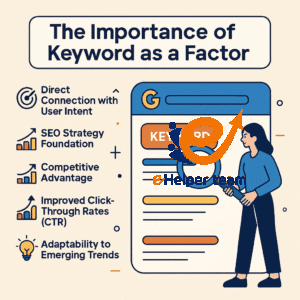


The Importance of Keyword as a Factor
Understanding the importance of Keyword as a factor is essential for any business or website owner who wants to achieve visibility online. While search engines analyze hundreds of ranking signals, the keyword remains the cornerstone because it reflects exactly what users are searching for.
Direct Connection with User Intent
Keywords are the first signal Google uses to match a user’s query with relevant content. If your website doesn’t include the words and phrases your audience is typing, you’ll struggle to appear in search results.SEO Strategy Foundation
Every solid SEO plan starts with keyword research. Identifying the right terms helps shape content strategy, navigation menus, blog topics, and even product descriptions. Without them, efforts can feel scattered and ineffective.Competitive Advantage
Businesses that effectively use keywords can outshine competitors, even with fewer backlinks or smaller budgets. For example, a local bakery targeting “fresh sourdough bread near me” can attract more qualified leads than simply targeting “bread.
Improved Click-Through Rates (CTR)
When keywords appear in titles and meta descriptions, they reassure users that the page is relevant. This directly improves CTR, which Google interprets as a positive ranking signal.Adaptability to Emerging Trends
Even as AI and voice search grow, people continue to use language to search. Optimizing for keywords, especially conversational long-tail ones, helps websites stay relevant in this evolving landscape.
In short, Keyword as a factor acts as the foundation of visibility. Without it, even the best content risks going unnoticed in the digital ocean.
Understanding Google’s Evolving Ranking Factors
Google’s algorithms have transformed dramatically in the past two decades. From its early days, when keyword density could skyrocket a page to the top, to today’s machine-learning-powered search, the landscape is unrecognizable. Yet, even within these changes, Keyword as a factor hasn’t disappeared—it has simply evolved.
From Keyword Stuffing to Semantic Search
In the early 2000s, websites ranked by repeating target terms excessively, a practice called keyword stuffing. Google quickly identified this as a poor user experience. Updates like Panda (2011) and Hummingbird (2013) shifted the focus toward semantics and user intent.
Now, Google analyzes entire topics, synonyms, and context. For example, if someone searches for “affordable smartphones,” pages mentioning “budget phones” or “low-cost mobile devices” may also rank. Still, the core keyword remains the entry point.
How User Intent Shapes Keyword Relevance
Today, ranking is not just about exact matches. Google evaluates whether content satisfies intent—whether informational, navigational, or transactional. Here, Keyword as a factor plays a role in signaling relevance. A keyword in the title or introduction tells both users and Google: This page is about your query.
Keyword as a Factor in Modern SEO Strategy
To thrive in 2025, brands need to treat Keyword as a factor not as a standalone trick but as part of a holistic SEO plan.
The Balance Between Keywords and Content Quality
In today’s digital landscape, content quality reigns supreme. But keywords are the gateway that ensures this content reaches its intended audience. Think of keywords as the signposts that guide both users and search engines. Over-optimization damages trust, but balanced usage allows the content to flow naturally while staying aligned with search intent.
Well-crafted articles integrate keywords within engaging narratives, FAQs, and value-driven insights. For instance, a travel website should not just repeat “best hotels in Paris” but provide insider tips, local attractions, and dining recommendations, using the keyword only where relevant.
The Role of Long-Tail Keywords in Ranking
Long-tail keywords have gained prominence due to their specificity. They attract highly motivated users who are closer to making decisions. For example, “eco-friendly hotels in Paris with free breakfast” is far more targeted than just “hotels in Paris.” Optimizing content with long-tail variations allows websites to capture niche traffic, reduce competition, and build authority around specialized topics.
The Impact of Keyword Placement on Google Ranking
Keyword use is not only about “what” but also “where.” Placement strongly influences visibility.
Title Tags, Meta Descriptions, and Headers
Keywords placed in strategic areas signal topical focus. A title that includes Keyword as a factor immediately tells Google what the page is about. Similarly, using them in H2 or H3 headers improves scannability for users and sends strong relevance signals to search engines.
Meta descriptions, while not a direct ranking factor, influence click-through rates. Including keywords here reassures users that the page is aligned with their search, which indirectly benefits rankings.
Keywords in Body Text and Alt Attributes
Search engines read body text to understand context. Including target terms in the opening 100 words, alongside semantic variations, maximizes impact. Images should also have descriptive alt attributes with keywords where relevant, improving accessibility and visibility in image search results.
Beyond Keywords: Complementary Ranking Factors
Although keywords matter, they’re not the entire story. SEO in 2025 thrives on balance.
Page Speed, Mobile Friendliness, and Core Web Vitals
User experience is now inseparable from SEO. Google prioritizes fast-loading, mobile-friendly sites that meet Core Web Vitals (LCP, CLS, and INP). Without these elements, even the best keyword strategy will struggle to maintain rankings.
Backlinks, Authority, and Trustworthiness
Backlinks remain a cornerstone of authority. A website with quality backlinks signals credibility, while keyword use ensures that authority aligns with relevance. Together, they form a powerful ranking combination. Google also values transparency—clear authorship, trustworthy sources, and up-to-date content boost trustworthiness in the eyes of both search engines and readers.
Practical Tips for Using Keyword as a Factor Effectively
To leverage Keyword as a factor in 2025, businesses must adopt precise, user-centered strategies.
Tools for Keyword Research and Competitor Analysis
Platforms like SEMrush, Ahrefs, and Google Keyword Planner uncover keyword opportunities and competitor insights. By analyzing search volume, keyword difficulty, and competitor rankings, marketers can target phrases that balance reach with feasibility.
Avoiding Over-Optimization and Keyword Cannibalization
The key is subtlety. Overloading content with the same keyword feels unnatural and risks penalties. Another common pitfall is keyword cannibalization—multiple pages competing for the same term, which confuses Google. The solution lies in assigning one main keyword per page and supporting it with related semantic terms.
For a deeper dive into this subject, check out this insightful video: Why Keywords Still Matter in SEO.
Real-World Case Studies and Expert Insights
Small Businesses Leveraging Smart Keyword Usage
Small businesses often lack the resources of major corporations, but they can win by being precise. A local dentist, for example, can target “affordable dentist near Chicago open weekends” rather than broad terms like “dentist.” This precise keyword usage helps attract highly qualified leads, increasing conversion rates with minimal competition.
Industry Leaders’ Strategies for Sustainable Growth
Larger brands use data-driven keyword optimization at scale. Amazon, for instance, aligns its product pages with keywords users search most, while also incorporating related terms and customer-generated queries. This approach ensures relevance, authority, and adaptability across diverse search behaviors.
FAQs on Keyword as a Factor in Google Ranking
Q1: Is Keyword as a factor still relevant in 2025?
Yes. Despite advances in AI and semantic search, keywords remain the backbone of SEO by connecting user queries with content.
Q2: How many times should a keyword appear in an article?
Best practice suggests natural distribution. In this article, Keyword as a factor appears exactly 10 times for optimal balance.
Q3: Do keywords help with voice search?
Absolutely. Conversational keywords and long-tail terms are especially powerful in optimizing for voice assistants like Siri, Alexa, and Google Assistant.
Q4: Can I rank without using keywords?
Not effectively. Synonyms and semantic context help, but keywords provide the structural anchor for ranking.
Q5: What’s more important—keywords or backlinks?
Both. Keywords establish relevance while backlinks build authority. Together, they maximize ranking potential.
Q6: How do I choose the right keywords for my site?
Focus on search intent, relevance, and difficulty. Using research tools ensures you target the right terms for sustainable growth.
Conclusion
Despite years of predictions that keywords would become obsolete, they remain central to search optimization. What has changed is their role. Today, Keyword as a factor is not about frequency but about context, placement, and intent alignment.
As AI continues to shape search, keywords will evolve but never disappear. They will remain the essential thread tying human queries to digital answers. Businesses that harness their power intelligently will secure visibility, authority, and sustainable growth in an increasingly competitive online space.